




India WTC Analysis: India’s WTC Hopes Hang in the Balance After Colombo Test Draw
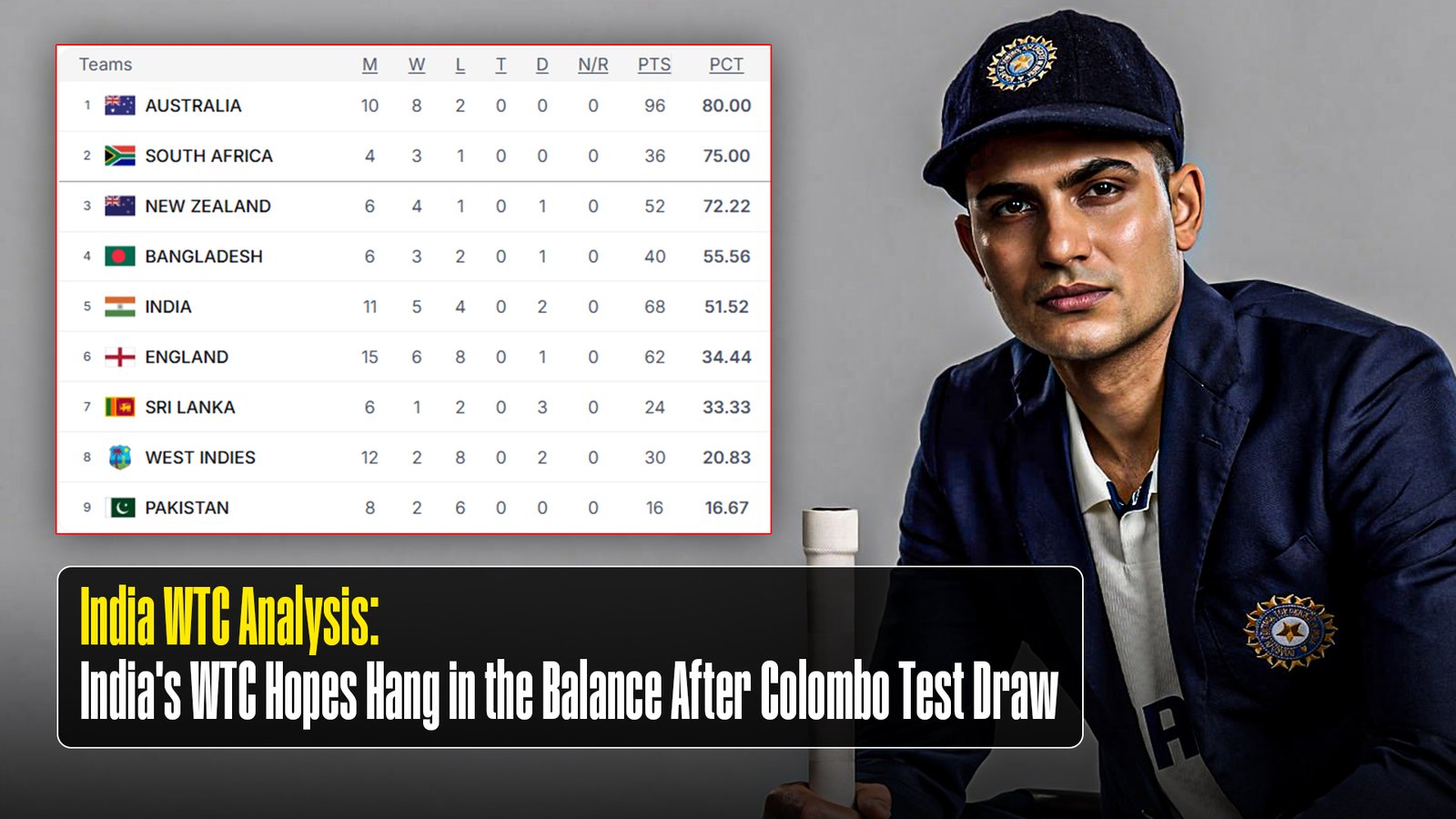
Fifty-one point five two. That single figure is where India’s World Test Championship story sits right now, and it tells you almost everything about the tightrope Shubman Gill’s side is walking. After the second Test against Sri Lanka in Colombo ended in a stubborn draw, India’s points percentage slipped from 53.33 to 51.52, and the team stayed put in fifth place on the WTC 2025-27 standings. It was a result that felt like a small step backward dressed up as a series win.
India took the two-match series 1-0 thanks to a commanding performance in Galle. But cricket, and the WTC in particular, rarely rewards them. The 2-0 scoreline that India chased in Colombo would have supercharged their percentage. Instead, a defiant Sri Lankan rearguard slammed the door shut, and India walked away with four points from a possible twelve.
How the Colombo Draw Unfolded
The final day at the Sinhalese Sports Club turned into a test of patience that India could not crack. Sri Lanka entered day five with a lead of just 16 and four wickets remaining, a situation that looked ripe for an Indian finish before lunch. It never came together that way.
Sonal Dinusha, who had already scored a century in the first innings, produced another monumental knock, finishing unbeaten on 133 and batting the hosts to safety across 154 overs. Left-arm spinner Manav Suthar kept beating the bat and eventually broke a 112-run stand by removing Keshara Nuwantha for 46, but Dinusha refused to budge. Lahiru Kumara chipped in with a stubborn 90-ball vigil that frustrated India further. By the time part-timers like Gill, Dhruv Jurel and Yashasvi Jaiswal were rolling their arms over, the writing was on the wall. The captains shook hands, and India’s charge for a bigger prize fizzled out.
That draw is the reason India’s percentage dropped rather than climbed. A win would have added twelve points. A draw handed over only four, and against a total of possible points that keeps growing, four is simply not enough to move up.
Where India Stand on the WTC Table
The current picture is not disastrous, but it is far from comfortable. India sit fifth with a PCT of 51.52, holding five wins, four defeats and two draws across their cycle so far. The teams ahead of them are pulling clear at the top.
Australia lead the standings with a formidable 80 percent, having won eight of their ten Tests. Defending champions South Africa follow at 75 percent, with New Zealand third at 72.22 percent. The surprise package sits in fourth, where Bangladesh have crashed the party at 55.56 percent thanks to a stunning win over Australia. India, at 51.52, are chasing that group rather than leading it.
The saving grace is the cushion below. England climbed to sixth after thumping Pakistan at Lord’s, but their PCT of 34.44 leaves a comfortable gap between them and India. So India is not in danger of sliding further right now. The problem is direction. Fifth place with a percentage in the low fifties is not where a two-time WTC finalist wants to be sitting, especially when history suggests you need around 60 percent or more to reach the final.
The Percentage Puzzle Explained
Newcomers to the WTC often wonder how a team can win a series and still lose ground. The answer lies in the format’s core mechanic. The table is ranked by points percentage, not by total points, because teams do not all play the same number of Tests in a cycle.
Every Test is worth twelve points. A win banks all twelve, a draw returns four, and a defeat gives nothing. When India drew in Colombo, they earned only a third of what was on offer, which dragged down the average that the percentage is built on. In other words, a draw is not a neutral result in the WTC. Against the yardstick of a possible clean sweep, it functions almost like a half-loss for a side chasing the top two.
Why There Is Still Plenty to Play For
Here is the encouraging part for Indian fans. India still have seven Tests remaining in this cycle, which is a substantial runway. That is seven fresh chances to bank twelve-point hauls and drag that percentage upward toward the qualification zone—a shift that would also dramatically alter the odds on any sport betting exchange.
Contrast that with England, who have just one Test left against Pakistan and very little room to climb. India’s fate remains largely in their own hands, and that is the most valuable currency in any WTC race. Win the majority of those seven matches, and a percentage in the low fifties can quickly become a percentage in the mid-sixties.
The margin for error, though, has shrunk. Every draw like the one in Colombo chips away at the buffer and puts more pressure on the fixtures ahead. India can afford a stumble or two across seven Tests, but they cannot afford to keep leaving points on the table through inconclusive finishes.
The Road Ahead Demands Ruthlessness
The lesson from Colombo is a simple one. Good is not good enough in this format. India dominated for large stretches of the series and still came away feeling shortchanged because they could not force the second win.
To climb into contention, India will need to convert dominant positions into outright victories rather than settling for control. The batting has looked solid, and the emergence of spinners like Manav Suthar, who ran through Sri Lanka in Galle, gives the attack real bite. What the side must add is the killer instinct to close games out on flat surfaces and stubborn final days. That is the difference between a team that qualifies and a team that finishes fifth wondering what might have been.
The WTC has a habit of coming down to the final few series, and India have been in exactly that position before. Their path to the summit clash is open, but it now requires a run of results rather than the occasional standout performance.
For a broader look at how another WTC contender is navigating a rocky patch, check out our coverage of how Pakistan eye big changes for Lord’s. It is a reminder that even sides at the bottom of the table are scrambling to rewrite their campaigns, and that no position in the WTC is ever truly settled.
The Bottom Line
India’s WTC hopes are alive, but they are hanging in a delicate balance. The Colombo draw was a reminder that series wins alone do not guarantee progress in a system built on percentages. With a PCT of 51.52 and seven Tests still to come, India control their own destiny, yet that destiny now demands consistency and a sharper edge. The talent is clearly there. The next chapter will be decided by how ruthlessly India can turn promising positions into full points. For a side that has reached two finals already, the target is clear, and the clock is ticking.
Frequently Asked Questions
- Why did India’s WTC percentage drop despite winning the series against Sri Lanka? India won the series 1-0 but could not secure the 2-0 scoreline they were chasing. The Colombo Test ended in a draw, which handed India only four points out of a possible twelve. Because the WTC table is ranked by points percentage, that reduced haul pulled India’s PCT down from 53.33 to 51.52.
- What is India’s current position on the WTC 2025-27 points table? India are in fifth place with a points percentage of 51.52. They have recorded five wins, four defeats and two draws in the current cycle so far.
- Which teams are ahead of India in the WTC standings? Australia lead at 80 percent, followed by South Africa at 75 percent, New Zealand at 72.22 percent and Bangladesh at 55.56 percent. India sit just behind that fourth-placed group.
- How many Tests does India have left in this WTC cycle? India still have seven Tests remaining, which gives them ample opportunity to boost their percentage and push toward the qualification zone for the final.
- What percentage does a team usually need to reach the WTC final? History suggests teams generally need around 60 to 64 percent to make it to the final. India’s current 51.52 percent means they have ground to make up, though their remaining fixtures give them a realistic chance.
- Who was the standout Sri Lankan performer in the Colombo Test? Sonal Dinusha was the star for the hosts. After scoring a century in the first innings, he added an unbeaten 133 in the second to anchor Sri Lanka’s marathon rearguard and secure the draw.
-

Abhishek Sharma breaks Virat Kohli’s eight year-old IPL record
• 20 May, 24 • by InkspilledAbhishek Sharma, has taken the IPL by storm this season, breaking Virat Kohli's eight-year-old record for the most sixes hit by an Indian player in a single season.
-

IPL 2024: Sixes Soar as Records Shatter in a Season of Big Hitting!
• 16 May, 24 • by InkspilledThe recent Delhi Capitals vs Lucknow Super Giants match on May 14 rewrote history. With 20 towering sixes hit, the IPL season's total tally of maximums of 1125 sixes!
-

WTC Update: Rohit Sharma’s Captaincy Shines, Aiming for the Top Spot
• 27 Feb, 24 • by InkspilledThe recent Test series between India and England witnessed a significant shift in the World Test Championship (WTC) standings. The Indian team, captained by Rohit Sharma, against England, not only sealed the series but also showcased a remarkable display of leadership and talent.