




History of Team India in International Cricket: From Underdogs to Superpower
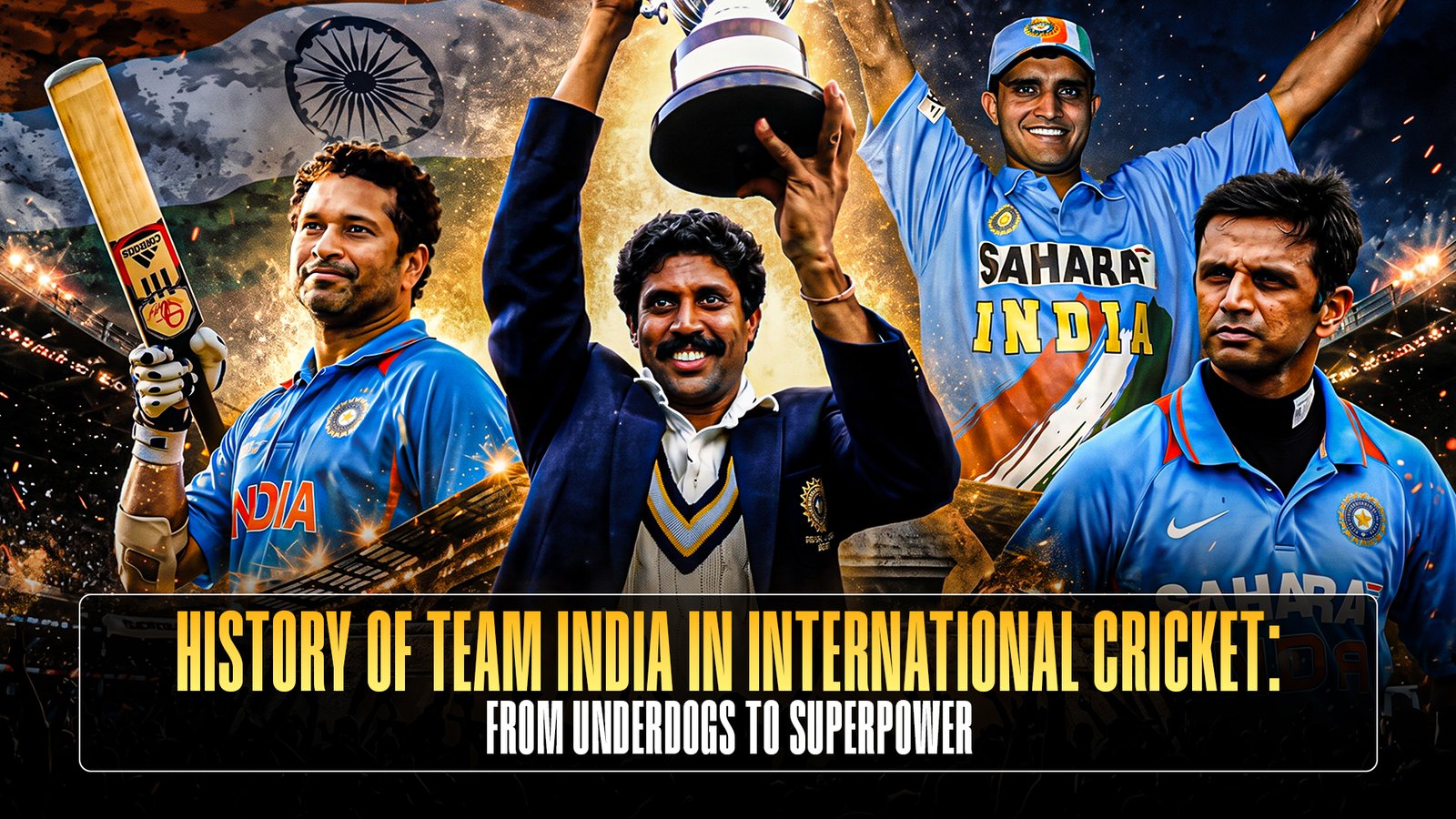
On June 25, 1932, a young Indian side walked out at Lord’s to play its first Test match. They lost, they were raw, and few gave them much of a future. Nine decades later, that same nation sits at the very top of world cricket, holding the ODI number one ranking and a cabinet full of global trophies. The journey between those two points is one of the greatest stories in sport.
This is the history of Team India in international cricket, a tale of patient struggle, a shock that changed everything, and a rise to a dominance few could have imagined. Let’s trace how the Men in Blue went from plucky underdogs to a genuine cricketing superpower.
The Early Years: A Long Apprenticeship
Every empire has humble beginnings, and India’s cricketing story started with two decades of hard lessons.
India earned Test status in 1932, becoming only the sixth nation to do so, with CK Nayudu leading that historic first side at Lord’s. But success did not come quickly. It took almost twenty years and 24 attempts before India finally recorded a maiden Test victory, beating England at Madras in 1952.
For much of the following decades, India were considered one of the weaker Test sides, winning only a handful of their early matches and struggling badly overseas. They were formidable at home on turning pitches but fragile abroad, a reputation that would take a generation to shake.
The 1970s: Spin, Steel and the First Signs of Greatness
The tide began to turn in the 1970s, thanks to a golden generation of talent.
This era produced Sunil Gavaskar, the run-machine who became the first batter to 10,000 Test runs, and Gundappa Viswanath, a wristy genius. Above all, it produced the legendary spin quartet of Bishan Singh Bedi, Erapalli Prasanna, Bhagwath Chandrasekhar and Srinivas Venkataraghavan, who bamboozled the world’s best.
Landmark overseas series wins in the West Indies and England in 1971 finally proved India could compete anywhere. The team was no longer just a home-track specialist. It had steel, and it had belief.
1983: The Shock That Changed Everything
If one moment defines the history of Team India, it is a June afternoon at Lord’s in 1983.
Kapil’s Devils Stun the World
India arrived at the 1983 World Cup as 66-to-1 outsiders. Nobody expected Kapil Dev’s side to trouble the mighty West Indies, who had won the first two World Cups at a canter. Yet India, bowled out for just 183 in the final, defended that modest total with extraordinary heart to topple the two-time champions.
The victory did not just win a trophy. It transformed cricket in India from a popular sport into a national obsession overnight. A billion dreams were born that day, and the commercial and cultural explosion that followed reshaped the entire global game.
Building on the Breakthrough
India backed up the fairytale with more silverware, winning the inaugural Asia Cup in 1984 and the World Championship of Cricket in Australia in 1985 under Sunil Gavaskar. The underdogs had become genuine contenders.
The Modern Era: The Rise of a Superpower
The turn of the millennium marked India’s transformation into a consistent global heavyweight. This shift did not just rewrite record books; it fundamentally changed how cricket is followed and analyzed globally. Today, India’s massive fan base and dominant performances heavily drive market volume on every major sport betting exchange, where live match odds, player performance markets, and tournament futures frequently swing around the Men in Blue.
The Ganguly and Tendulkar Foundation
Sourav Ganguly instilled a fearless, aggressive culture in the early 2000s, famously celebrating shirtless on the Lord’s balcony after the 2002 NatWest Series win. That mindset laid the platform for everything that followed, powered by the genius of Sachin Tendulkar, the most prolific run-scorer the game has ever seen. India climbed the Test rankings and started winning matches in conditions that had long tormented them.
The Dhoni Golden Age
Then came the trophies. Under MS Dhoni, India won the inaugural T20 World Cup in 2007, the 2011 ODI World Cup on home soil, and the 2013 Champions Trophy, completing a clean sweep of every major ICC white-ball title.
The launch of the Indian Premier League in 2008 accelerated everything, creating the richest league in cricket and a fearless new generation of stars who now play without any hint of the old inferiority complex.
Conquering the Final Frontiers
The most recent chapter has been about turning dominance into sustained, all-format supremacy.
Under Virat Kohli’s fierce leadership, India became a ruthless Test unit, achieving the once-unthinkable feat of back-to-back Test series wins in Australia in 2018-19 and 2020-21. They also reached the final of the inaugural World Test Championship, cementing their status as the world’s most complete side. Crucially, this all-format strength rested on a supply line of talent from a deep domestic system, and understanding how India’s domestic cricket structure works, from the Ranji Trophy to the Duleep Trophy, reveals exactly why the national side has rarely been short of world-class replacements.
The silverware kept coming. After a brief ICC-title drought, India won the T20 World Cup in 2024 under Rohit Sharma, followed by the 2025 Champions Trophy, and then a second successive T20 World Cup crown in 2026 with a final win over New Zealand. From one Test win in twenty years to serial global champions, the transformation was complete.
Conclusion
The history of Team India in international cricket is a remarkable arc from vulnerability to invincibility. It began with a heavy defeat at Lord’s in 1932 and a painful two-decade wait for a first win. It turned on the seismic shock of 1983, matured through the Tendulkar and Dhoni eras, and reached full bloom with modern all-format dominance and a stack of world titles. Today, the Men in Blue are not just competitive; they set the standard, backed by the deepest talent pool in world cricket. The underdogs of Lord’s have become the team everyone else measures themselves against, and their story is still being written.
Frequently Asked Questions (FAQs)
- When did India play its first international cricket match? India played its first Test match on June 25, 1932, against England at Lord’s in London, led by captain CK Nayudu. It became the sixth nation to achieve Test status.
- When did India win its first Test match? India recorded its maiden Test victory in 1952, beating England at Madras (now Chennai). It came almost twenty years and 24 matches after their debut.
- How many ICC World Cups has India won? India has won the ODI World Cup twice, in 1983 and 2011, and the T20 World Cup three times, in 2007, 2024 and 2026, alongside Champions Trophy titles in 2002, 2013 and 2025.
- Why was the 1983 World Cup win so important? Beating the dominant West Indies as huge underdogs transformed cricket in India from a popular sport into a national obsession, triggering the commercial boom that reshaped the global game.
- Who are India’s most successful captains? MS Dhoni is the most decorated, winning the 2007 T20 World Cup, 2011 ODI World Cup and 2013 Champions Trophy. Virat Kohli built India’s most dominant Test era, and Rohit Sharma added the 2024 T20 World Cup.
- What is India’s current status in world cricket? India is among the strongest teams across all formats, holding the number one ODI ranking and ranking near the top in Tests and T20Is, backed by a deep domestic system and global titles.
-

Trent Boult Signs Off from The T20I World Cup
• 21 Jun, 24 • by InkspilledNew Zealand pace legend Trent Boult has drawn the curtains on his T20 World Cup career, leaving a bittersweet taste in fans' mouths.
-
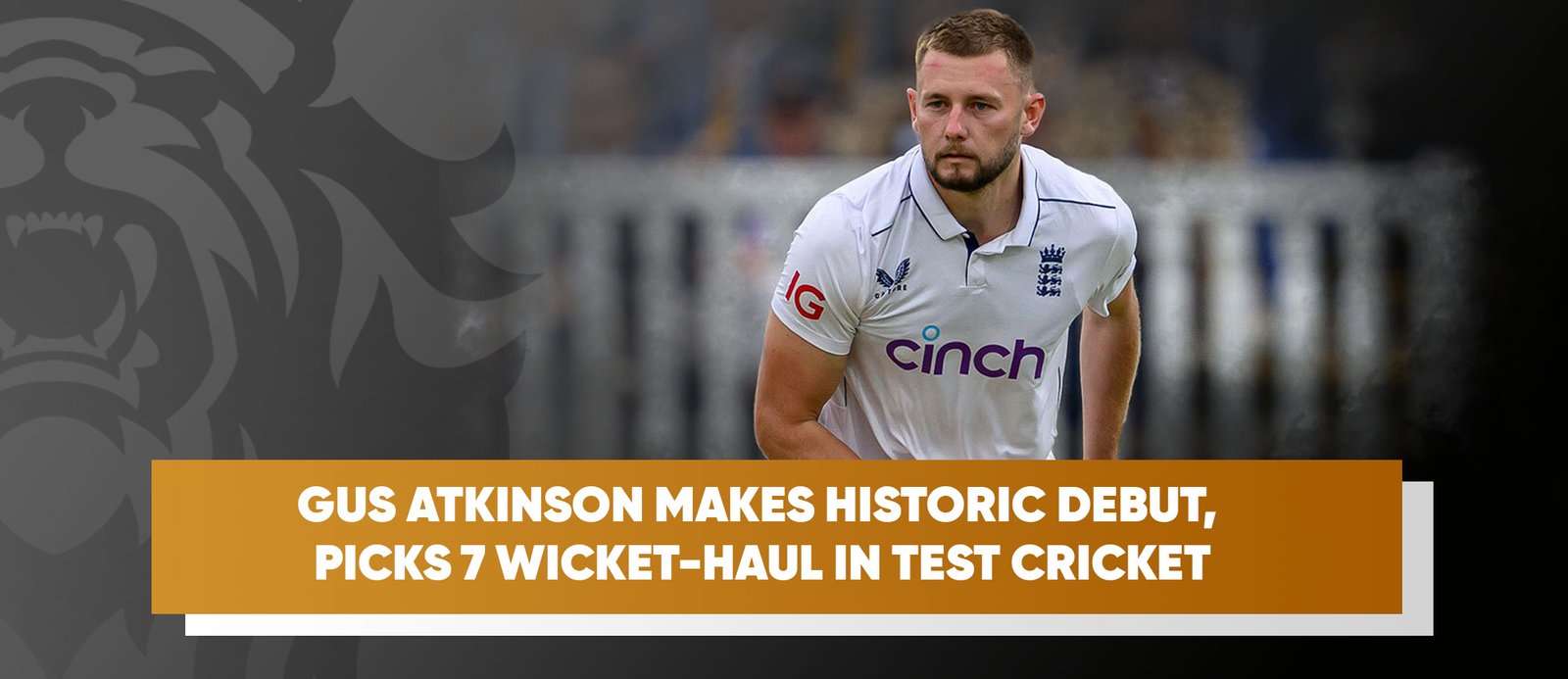
Gus Atkinson makes historic debut, Picks 7 Wicket-Haul in Test Cricket
• 12 Jul, 24 • by InkspilledPlaying against West Indies at Lords, England’s player Gus Atkinson has made a historic debut. Imagine bowling in your first ever Test match, at the historic Lord's
-

Yuzvendra Chahal Reaches 100 First-Class Wickets
• 11 Sep, 24 • by InkspilledYuzvendra Chahal, the Indian leg-spinner, reached a significant milestone during his county stint with Northamptonshire. He surpassed 100 first-class wickets