

India Reaches 300 T20Is With 200 Wins, Marking a New Era in Cricket
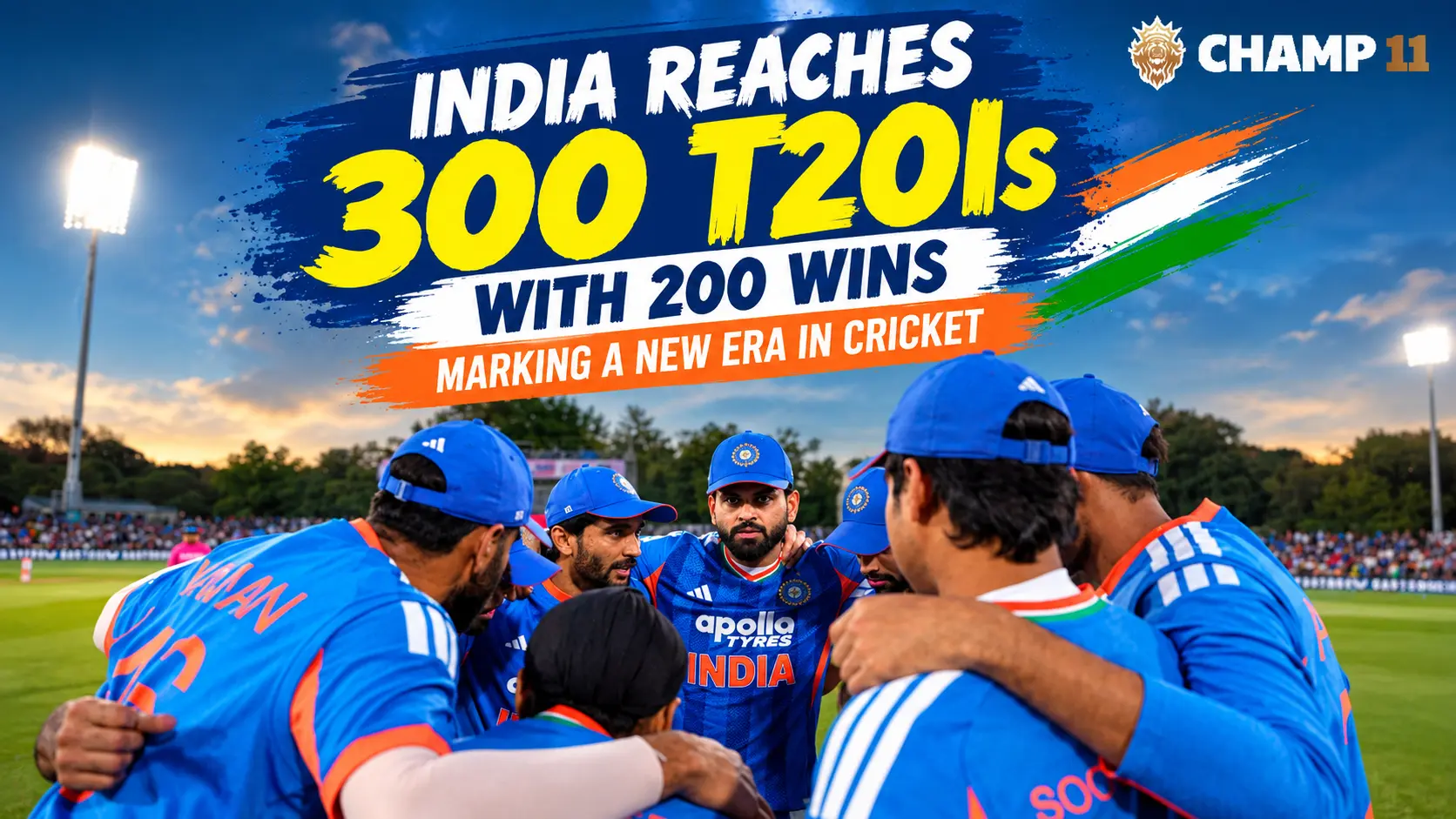
India’s 300th T20 International marked a historic milestone as the team registered its 200th victory in the format, underlining its remarkable transformation into a dominant force in world cricket.
India has reached a significant milestone in its T20 International journey, completing 300 matches and securing its 200th victory in the landmark game against New Zealand. The achievement reflects nearly two decades of evolution, from the early days of T20 cricket to an era defined by aggressive batting, innovative strategies and major international titles.
The historic victory came in the second T20I against New Zealand at Christchurch’s Hagley Oval on October 24, 2026. India faced a challenging run chase before Tilak Varma and Nitish Kumar Reddy combined to deliver a memorable finish.
With 68 runs required from the final five overs and six wickets already down, India needed a substantial contribution from its remaining batters. Varma scored an unbeaten 51 off 26 deliveries, while Reddy contributed 26 not out from just 13 balls. Their unbeaten 69-run partnership guided India to victory with one ball remaining.
The result was more than another addition to India’s win column. It represented a defining moment in the team’s journey through the shortest international format.
India’s T20 Journey: From a Debut Victory to 300 Matches
India played its first men’s T20 International against South Africa in Johannesburg on December 1, 2006, under the captaincy of Virender Sehwag.
Batting first, South Africa managed 126/9. India’s bowlers kept the opposition under control, with Zaheer Khan and Ajit Agarkar making important contributions.
During the chase, Sehwag scored 34, while Dinesh Mongia added 38 to steady the innings. Dinesh Karthik then helped India cross the finish line, hitting a six and a boundary in the final over to secure a six-wicket victory with one ball remaining.
That opening performance began a journey that would eventually establish India as one of the most successful teams in T20 International cricket.
India took approximately 11 years and seven months to complete its first 100 T20Is. The next 200 matches came at a considerably faster pace, with the team completing the journey from 200 to 300 matches in just over three years.
This acceleration reflects the growing importance of T20 cricket in India’s international calendar and the team’s increasingly prominent role in the format.
Also Read: Kieron Pollard Praises Naman Dhir, Says Mumbai Indians Star Has More to Achieve
The 2007 T20 World Cup Changed Indian Cricket
Although India won its first T20 International in 2006, the format initially took time to gain widespread acceptance among Indian cricket fans.
That changed dramatically at the inaugural ICC Men’s T20 World Cup in South Africa in 2007.
Led by MS Dhoni, India defeated Pakistan in a memorable final to lift the trophy. The image of Sreesanth taking the decisive catch to dismiss Misbah-ul-Haq became one of the defining moments in Indian cricket history.
The victory helped establish T20 cricket as a major attraction in India and contributed to the format’s growing popularity.
However, India’s subsequent World Cup campaigns demonstrated that early success did not automatically guarantee sustained dominance.
The team reached the semifinals in 2016 but lost to the West Indies. Its 2021 campaign ended in the group stage, while England eliminated India with a 10-wicket victory in the 2022 semifinals.
These setbacks exposed the need for a more adaptable approach to the shortest format.
Rohit Sharma and Virat Kohli Helped Shape a New Generation
India’s development as a T20I powerhouse was influenced by several outstanding batters, particularly Rohit Sharma and Virat Kohli.
Rohit’s ability to attack from the beginning, combined with his experience and leadership, helped India navigate different match situations. He finished his T20I career with 4,231 runs and five centuries.
Kohli, meanwhile, built a reputation for consistency, composure and match-winning performances under pressure. He accumulated 4,188 runs in T20Is and maintained a career batting average of 48.69.
Their contributions helped establish a foundation for the next generation of Indian batters.
Over time, India’s batting approach became increasingly aggressive. Rather than relying primarily on individual performances or late acceleration, the team developed a strategy that encouraged attacking cricket across multiple positions.
A notable example came in October 2024, when India scored 297/6 against Bangladesh in a T20 International. The innings included 22 sixes and demonstrated the team’s ability to maintain an exceptionally high scoring rate.
This change in approach has become a defining feature of modern Indian T20 cricket.
Also Read: IPL 2027 Auction Date Announced: Goa to Host Mini-Auction on December 16
Bowling Strength Continues to Support India’s Success
While India’s batting evolution has attracted considerable attention, its bowling attack has also played a crucial role in the team’s progress.
Jasprit Bumrah has emerged as one of India’s most influential T20 bowlers, particularly because of his effectiveness during the closing overs of an innings. His variations, control and ability to perform under pressure have made him a valuable asset.
Other bowlers, including Bhuvneshwar Kumar and Yuzvendra Chahal, have contributed significantly to India’s performances across different phases of T20 matches.
Deepak Chahar also created a memorable moment in November 2019, when he became the first Indian bowler to take a hat-trick in men’s T20Is. He finished that match against Bangladesh with figures of 6/7.
Arshdeep Singh has subsequently established himself as one of India’s leading wicket-takers in the format, highlighting the continued development of the team’s bowling resources.
The combination of aggressive batting, specialist death bowling and greater tactical flexibility has helped India become a formidable opponent in international T20 cricket.
From the 2024 Triumph to Back-to-Back World Cup Titles
India’s wait for another T20 World Cup trophy after its inaugural 2007 triumph ended in 2024.
Under Rohit Sharma’s leadership, India defeated South Africa in a closely contested final in Barbados to win the tournament. The victory was especially significant for a team that had endured several disappointing World Cup campaigns in the preceding years.
The 2024 triumph also marked the conclusion of an important chapter in Indian T20 cricket. Rohit Sharma, Virat Kohli and Ravindra Jadeja subsequently retired from T20 Internationals, creating opportunities for younger players to take on greater responsibilities.
India successfully defended its title in 2026, winning the tournament at home under Suryakumar Yadav’s leadership.
The consecutive championships demonstrated the team’s ability to transition between generations while maintaining its competitive edge.
Rather than depending exclusively on established stars, India built a squad capable of adapting to different conditions, changing match situations and the demands of modern T20 cricket.
India’s Record After 300 T20 Internationals
India’s 300th T20I provides an opportunity to assess its achievements in the format.
According to the figures reported for the milestone, India recorded 200 victories in its first 300 T20Is when counting matches won in regular play. Including victories secured through tie-breakers, the total rises to 206.
The team’s record also includes 83 defeats, seven tied matches and 10 matches without a result.
These numbers place India among the leading teams in the history of men’s T20 International cricket. Pakistan was the first country to reach the 300-match mark, making India the second team to achieve the milestone.
India’s success reflects more than the number of matches won. Its ability to adapt to changing strategies, develop younger players and remain competitive across multiple generations has been central to its sustained progress.
Tilak Varma’s Journey Mirrors India’s Transformation
Tilak Varma’s contribution to India’s 300th T20I victory added another layer of significance to the occasion.
Varma made his T20I debut in India’s 200th match in the format, against the West Indies. He scored 39 runs off 22 deliveries in a match India lost by four runs.
A century of T20Is later, he played a decisive role in securing India’s 200th victory, producing an unbeaten half-century under pressure.
His development reflects the broader transformation of Indian T20 cricket. Young players are increasingly being trusted with important responsibilities, and the team’s approach encourages them to make decisive contributions in high-pressure situations.
Varma’s innings against New Zealand demonstrated the value of composure, adaptability and the ability to accelerate when the situation demands it.
What India’s 300-Match Milestone Means for the Future
India’s journey through 300 T20 Internationals illustrates how dramatically the format has evolved since the team’s debut in 2006.
The early years were defined by experimentation and the excitement surrounding a relatively new format. Subsequent campaigns brought major victories, painful defeats and important tactical lessons.
Today, India’s approach combines aggressive batting, flexible team selection, specialist bowling options and a steady pipeline of young talent.
The challenge will be to maintain these standards as international teams continue to develop new strategies and compete for major titles.
For cricket fans, India’s 300th T20I is both a celebration of past achievements and a reminder of how quickly the sport continues to change.
As the team looks ahead, its ability to combine experience with emerging talent will remain crucial to its ambitions in international cricket.
For readers who enjoy following cricket developments, match discussions and the wider cricketing ecosystem, visit Champ11 Official for more cricket-related content.
India’s milestone ultimately represents a journey of adaptation and ambition. From a six-wicket victory in Johannesburg to its 200th win across 300 T20 Internationals, the team has established a record that reflects its growing influence on the modern game.