

How to Analyze a T20 Cricket Match Before Betting
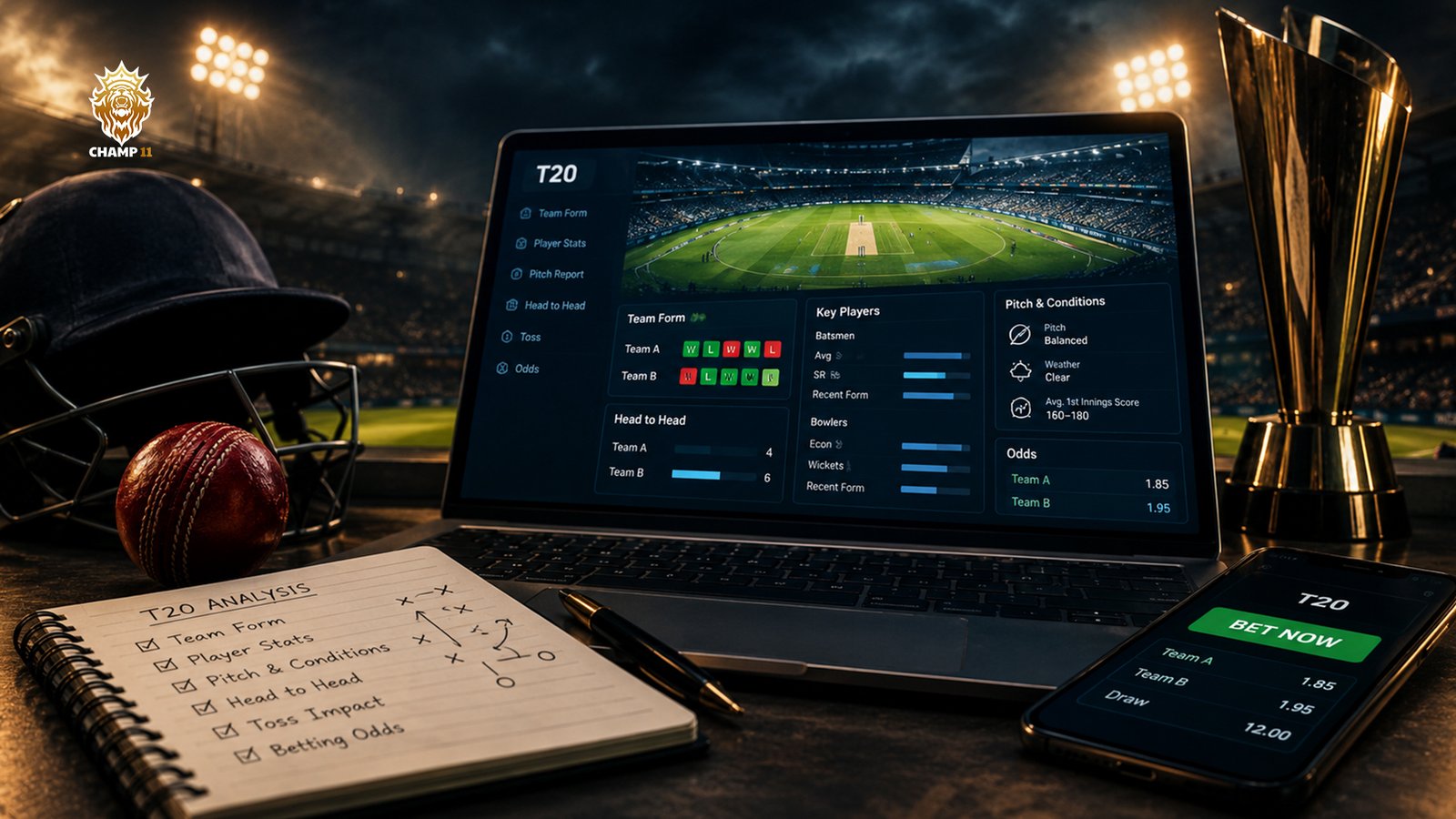
T20 cricket is fast, unpredictable and heavily influenced by short periods of play. A few overs can change the entire match, which makes simply looking at a team’s win-loss record insufficient for serious pre-match analysis.
If you are researching a T20 match before making a real-money betting decision, look beyond the headline numbers. Team form, pitch conditions, player availability, batting depth, bowling options, powerplay performance, death-over performance, weather and match-ups can all provide useful context.
The key is to treat these factors as evidence rather than guarantees. No statistical method can remove the uncertainty inherent in a T20 cricket match.
What Should You Analyze Before a T20 Match?
A practical T20 analysis checklist includes:
- Recent team performance
- Venue and pitch characteristics
- Batting strength
- Bowling strength
- Powerplay performance
- Middle-over performance
- Death-over performance
- Player availability and current form
- Weather and playing conditions
- Toss and confirmed playing XI
- Relevant statistics and sample sizes
Looking at several factors together is generally more informative than relying on a single statistic.
1. Check Recent Team Form
Start with the teams’ recent performances, but don’t stop at the win-loss record.
Look at how the teams are actually performing during matches.
Useful questions include:
- Are they consistently scoring during the powerplay?
- Are they losing wickets early?
- How often are they conceding runs at the death?
- Are their middle overs productive?
- Are they successfully defending totals?
- Are they chasing effectively?
A team may have won several recent matches while relying on unusually strong individual performances. Conversely, a team may have lost close matches despite producing competitive underlying numbers.
This is why recent results should be treated as context rather than a guarantee of what happens next.
2. Analyze the Pitch and Venue
The venue can have a major influence on T20 tactics.
Before a match, research the characteristics of the ground and, where available, recent matches played on the same surface.
Consider:
- Average first-innings scores
- Average successful chase scores
- Boundary dimensions
- Pace of the surface
- Spin assistance
- Seam movement
- Dew
- Recent scoring patterns
A pitch that allows the ball to come onto the bat quickly may reward aggressive stroke play. A slower surface can place greater importance on bowling variations, spin and shot selection.
However, historical venue statistics should not automatically be treated as a prediction. Pitch conditions can vary from match to match.
3. Compare Batting Strength
Don’t judge batting strength solely by the names in the lineup.
Break the batting order into roles.
Opening Pair
Examine whether the openers consistently provide fast starts while preserving wickets.
Useful statistics include:
- Powerplay runs
- Powerplay strike rate
- Boundary percentage
- Dismissals during the powerplay
Middle Order
The middle order must often handle a different situation.
Check whether the team has batters capable of rotating the strike against spin and accelerating when required.
Finishers
The final overs can dramatically change a T20 innings.
Look at:
- Strike rate in the final overs
- Boundary frequency
- Runs against pace
- Runs against spin
- Dismissal frequency
A team with several capable finishers may have more options when setting or chasing a target.
4. Analyze the Bowling Attack
Batting statistics are only half the equation.
Break the bowling attack into phases.
Powerplay Bowlers
Look at:
- Early wickets
- Economy rate
- Dot-ball percentage
- Runs conceded in the first six overs
Middle-Over Bowlers
Spin and pace-off options can become particularly relevant during the middle overs.
Consider:
- Economy rate
- Wickets
- Dot balls
- Match-ups against opposing batters
Death-Over Bowlers
The final overs are often one of the most difficult phases to bowl.
Study:
- Death-over economy
- Wickets
- Yorker usage
- Slower-ball effectiveness
- Boundary percentage conceded
A team’s overall bowling average can hide major differences between these phases.
5. Study Powerplay, Middle and Death Overs
A useful way to analyze a T20 match is to divide the innings into three stages.
| Phase | What to examine |
|---|---|
| Powerplay | Runs, wickets, boundaries, dot balls |
| Middle overs | Strike rotation, spin performance, wickets |
| Death overs | Boundary rate, economy, finishing |
This approach can reveal strengths that a simple overall average misses.
For example, a team may have an average overall run rate but an excellent powerplay and unusually weak death overs. Another team could have the opposite profile.
The interaction between these phases can be more informative than a single headline statistic.
6. Check Player Form and Availability
Player availability can materially change a T20 team’s balance.
Before analyzing a match, check:
- Confirmed playing XI
- Injuries
- Suspensions
- Rest/rotation
- Recent workload
- Role changes
- Replacement players
A missing opening batter, death bowler or all-rounder can affect several parts of the team’s strategy.
Projected lineups should not be treated as confirmed information. Whenever possible, verify the final playing XI through a reliable source.
7. Consider Toss and Weather Conditions
The toss can influence tactical decisions, but its importance depends on the venue and conditions.
Possible factors include:
- Dew later in the evening
- Rain
- Cloud cover
- Wind
- Humidity
- Pitch deterioration
For example, if a wet outfield or heavy dew is expected, fielding conditions may change later in the game.
But avoid treating the toss as an automatic reason to favor one outcome. Its effect depends on the specific venue, weather and team strategy.
8. Use Statistics Without Overvaluing Them
Statistics are useful when they answer a specific question.
Some important T20 metrics include:
Batting strike rate:
Measures scoring speed relative to balls faced.
Bowling economy rate:
Measures runs conceded per over.
Dot-ball percentage:
Shows how frequently a bowler prevents scoring.
Boundary percentage:
Shows how much of a batter’s scoring comes through boundaries.
Powerplay scoring rate:
Helps assess early-innings aggression.
Death-over economy:
Helps assess bowling performance in the highest-risk scoring phase.
However, always consider sample size.
A statistic based on three innings should not automatically carry the same weight as one based on dozens of innings.
9. Look at Player Match-Ups
T20 cricket can contain important individual match-ups.
For example, a batter may perform particularly well against pace but struggle against quality spin.
Likewise, a bowler may have a strong record against aggressive right-handed batters but a different record against left-handers.
When using match-up statistics, check:
- Number of deliveries
- Number of dismissals
- Runs scored
- Strike rate
- Recent encounters
Small samples can be misleading, so match-up data should complement rather than replace broader performance data.
10. Don’t Ignore Uncertainty
One of the biggest mistakes in T20 analysis is assuming that a large amount of information produces certainty.
It doesn’t. A team can:
- Lose early wickets unexpectedly
- Produce an exceptional individual performance
- Suffer an injury during the match
- Experience changing weather
- Misjudge the pitch
- Win despite unfavorable pre-match statistics
Good analysis therefore describes probabilities, scenarios and evidence, not guaranteed results.
Common T20 Analysis Mistakes
Relying only on recent wins
Winning five matches in a row doesn’t automatically mean a team will win the next match.
Ignoring the venue
Team strength can interact significantly with the playing conditions.
Looking only at batting averages
T20 cricket is heavily influenced by scoring speed, wickets and match phases.
Ignoring bowling depth
A strong batting lineup does not eliminate the need for reliable bowling.
Using tiny statistical samples
Short-term numbers can be affected by unusual performances.
Assuming the toss decides the match
The toss can affect tactics, but it does not determine the result.
Trusting unverified team news
Always distinguish confirmed information from predicted lineups and social-media speculation.
A Simple T20 Match Analysis Checklist
Before making any decision, ask:
- What is each team’s recent form?
- How have they performed at this venue?
- What are the pitch characteristics?
- Which team has stronger powerplay batting?
- Which team has better death-over batting?
- Which team has better powerplay bowling?
- Which team has reliable death bowling?
- Are important players unavailable?
- What are the weather conditions?
- What does the confirmed XI look like?
- Are the statistics based on a meaningful sample?
- Am I confusing analysis with certainty?
- What limits have I set for my own spending?
Responsible Betting Matters
Match analysis should not be viewed as a way to guarantee income.
If you choose to participate in real-money betting where it is lawful, only use money you can afford to lose, set limits before playing, and avoid chasing losses.
Rules concerning online gambling and real-money gaming can differ by jurisdiction and can change over time. Check the laws that apply to your location and the terms of the service you use before participating.
For readers in India, legal and regulatory conditions surrounding online gaming have changed substantially in recent years, so generic claims that a particular form of online betting is universally legal should be avoided.
Frequently Asked Questions
How do you analyze a T20 cricket match before betting?
Analyze recent team form, venue conditions, pitch behavior, batting and bowling strength, player availability, powerplay and death-over statistics, weather and the confirmed playing XI. Use multiple factors rather than relying on one statistic.
Which statistics are most important in T20 cricket?
Useful statistics include batting strike rate, runs, wickets, bowling economy rate, dot-ball percentage, powerplay performance and death-over performance. Their importance depends on the player’s role and the match situation.
Why is pitch analysis important in T20 cricket?
Pitch characteristics can influence batting, pace bowling and spin bowling. However, historical pitch statistics should be treated as evidence rather than a guaranteed indicator of the next match.
How important is the toss in T20 cricket?
The toss can influence whether a team chooses to bat or field, particularly when weather or dew is relevant. Its actual impact varies according to the venue and conditions.
Should recent form be considered?
Yes, but recent form should be considered alongside longer-term performance, opponent quality, venue, player availability and match conditions.
Can statistics predict a T20 match result accurately?
Statistics can improve the quality of analysis but cannot guarantee a result. T20 cricket contains substantial randomness and individual performances can quickly change a match.
What is the biggest mistake in T20 match analysis?
One common mistake is relying on a single factor, such as recent wins, a famous player, the toss or one head-to-head statistic. A stronger approach considers several independent factors.
Can anyone guarantee a winning cricket bet?
No legitimate analysis can guarantee a winning result. T20 matches are uncertain, and claims of guaranteed profits should be treated with caution.
Final Takeaway
A useful T20 match analysis is built from several pieces of evidence: team form, pitch and venue, batting depth, bowling resources, match-ups, player availability, powerplay performance, death-over performance and weather.
The objective should not be to find a “guaranteed winner.” Instead, use reliable information to understand the possible scenarios, recognize uncertainty and make responsible decisions within your own limits.
For more cricket-related content, you can add a contextual internal link here to your site’s relevant cricket or match-analysis page rather than using the same commercial anchor repeatedly.
-
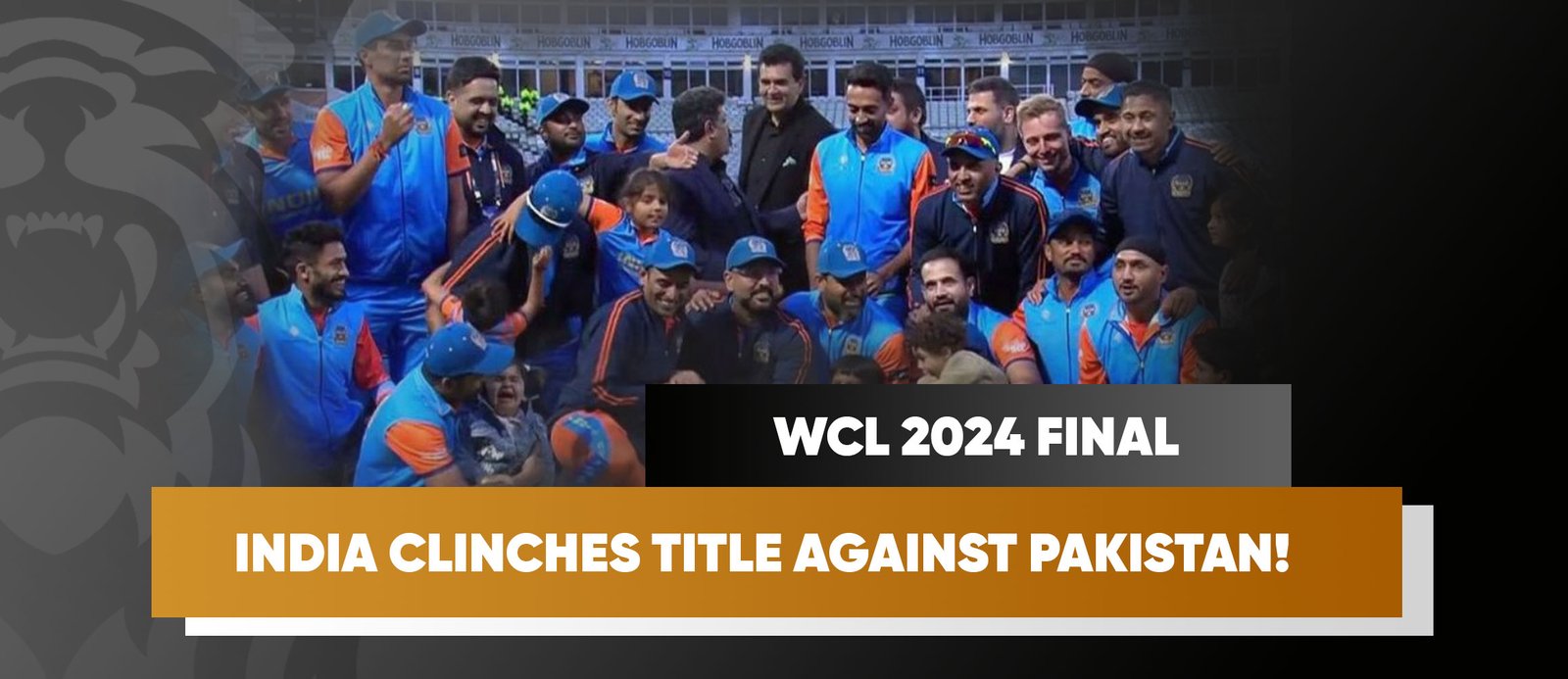
WCL 2024 Final: India Clinches Title Against Pakistan!
• 15 Jul, 24 • by Champ11Cricket fans, get ready for a nostalgia trip! In a thrilling finale to the World Championship of Legends (WCL), India's veteran team, led by the iconic Yuvraj Singh,
-

Joe Root’s Twin Centuries Shatter Records at Lord’s
• 02 Sep, 24 • by Champ11In a historic Test match at Lord's, Joe Root etched his name in the annals of cricket history by breaking multiple records, reaffirming his status
-

BCCI & Jay Shah Rewards Domestic Cricketers with Prize Money
• 27 Aug, 24 • by Champ11The Board of Control for Cricket in India (BCCI) has taken a significant step to recognize and reward outstanding performances in domestic cricket.