

Virat Kohli’s Greatest ODI Records and What They Tell Us About His Career
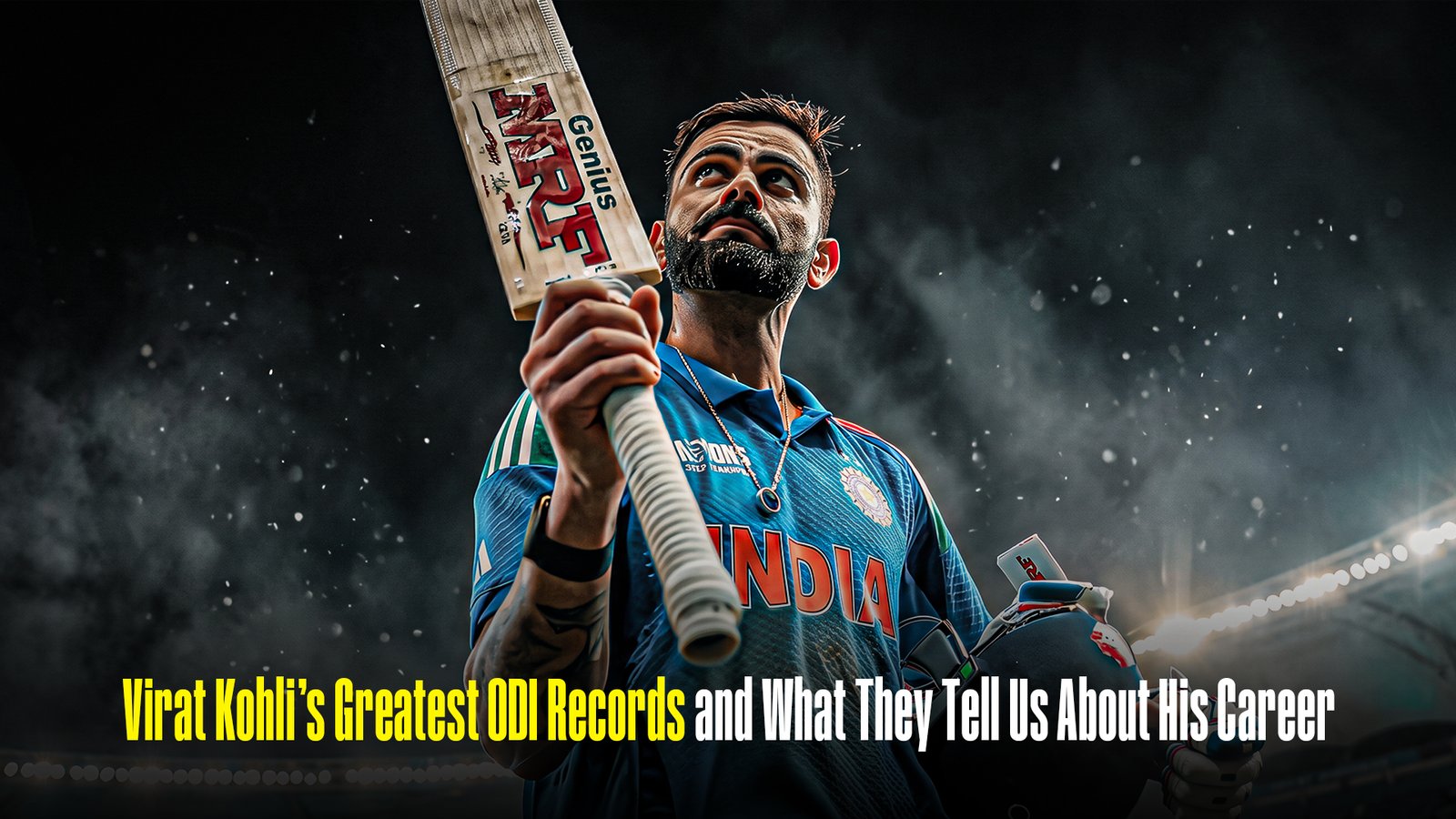
Virat Kohli’s ODI career is defined by more than a collection of impressive numbers. His records reveal a pattern of consistency, longevity, adaptability and an ability to perform when matches demand controlled run-scoring.
In September 2026, Kohli reached another major milestone by becoming the fastest batter to score 15,000 runs in men’s ODIs, reaching the landmark in 315 innings. He also became only the second men’s ODI batter after Sachin Tendulkar to reach 15,000 runs.
His record collection also includes the most ODI centuries, a record-breaking 2023 World Cup campaign and an extensive history of successful ODI chases.
But what do these numbers actually tell us about Kohli’s career?
Virat Kohli ODI Records at a Glance
| Record | Record Kohli’s achievement |
|---|---|
| ODI runs | 15,000+ |
| ODI centuries | 55 |
| Fastest to 15,000 ODI runs | 315 innings |
| Highest ODI score | 183 |
| 2023 World Cup runs | 765 |
| World Cup matches | 37 |
| World Cup runs | 1,795 |
| World Cup centuries | 05 |
Kohli’s latest 15,000-run milestone came during India’s first ODI against West Indies in September 2026. He scored 139 not out in that match, including his 55th ODI century, as India successfully chased 296.
These figures show the scale of his ODI career, but individual records become more meaningful when viewed in context.
Most ODI Centuries
One of Kohli’s defining records is his position at the top of the ODI century list.
He scored his 50th ODI century during the 2023 Cricket World Cup semi-final against New Zealand, surpassing Sachin Tendulkar’s previous record of 49 ODI hundreds.
By September 2026, Kohli had extended that total to 55 ODI centuries.
The record says something important about his batting style: Kohli has consistently converted substantial innings into hundreds.
A century requires more than aggressive stroke-making. It requires concentration, fitness, strike rotation and the ability to adapt as the match situation changes.
That conversion ability has therefore become one of the defining characteristics of his ODI career.
Fastest to 15,000 ODI Runs
Kohli’s 15,000-run milestone provides another way to understand his career.
He reached the mark in 315 innings, becoming the fastest batter to reach 15,000 ODI runs. He had previously held the record for reaching 8,000 through 14,000 ODI runs as quickly as any batter.
Only Sachin Tendulkar had previously crossed 15,000 ODI runs.
This record highlights efficiency.
A player’s total number of runs can be influenced by how long they play, but reaching a milestone in fewer innings demonstrates how consistently a batter accumulated runs when selected and available.
Kohli’s progression through the 8,000-to-15,000 range also demonstrates how sustained his ODI production has been.
Kohli’s 765 Runs in the 2023 World Cup
Perhaps the most remarkable tournament statistic in Kohli’s career came at the 2023 Cricket World Cup.
He scored 765 runs in 11 matches, including three centuries and six fifties.
That remains the highest individual run aggregate by a batter in a single men’s Cricket World Cup edition. The performance earned him the Player of the Tournament award.
Kohli scored at least a half-century in nine of his 11 innings during that tournament.
This record tells us something different from his 15,000-run milestone.
Instead of measuring long-term consistency, it demonstrates his ability to maintain high-level production throughout an entire major tournament.
Kohli’s World Cup Run-Scoring Record
Kohli has also established himself as one of the most productive batters in World Cup history.
Across 37 World Cup matches, he has scored 1,795 runs at an average of 59.83, with five centuries and 12 fifties.
His first World Cup appearance came in 2011, when India won the tournament.
He subsequently played in the 2015, 2019 and 2023 editions. His 2023 campaign was particularly significant because he combined tournament consistency with several major records.
The numbers show that his World Cup contribution has not been limited to one edition.
His ODI Consistency and Average
Run totals and centuries attract the most attention, but batting average provides another useful measurement.
Kohli’s ODI career has been built around maintaining a high average while also producing a large volume of runs.
His ability to pace an innings is a major part of that equation.
Rather than treating every delivery as an opportunity for maximum aggression, Kohli has often built innings through singles, doubles and selective boundary hitting before accelerating when required.
Former India coach Ravi Shastri highlighted Kohli’s awareness of match situations and his ability to take singles and control the tempo of an innings when discussing his ODI batting.
That approach helps explain why his statistics combine a high average with a large number of centuries.
A Record Built Around Successful Chases
Another major part of Kohli’s ODI reputation is his performance while chasing targets.
His batting has frequently involved calculating the required run rate, preserving wickets and increasing the scoring rate as the innings progresses.
The ICC has described his ability to pace innings and perform in challenging chases as a defining part of his career.
His latest 139 not out against West Indies in September 2026 provided another example.
India needed 296, and Kohli remained unbeaten as the team completed the chase in 41.4 overs.
The significance of these performances goes beyond the final score.
Successful ODI chases require a batter to constantly reassess the equation. A player may need to attack one bowler, rotate strike against another and protect wickets when required.
Kohli’s career record shows how important that skill has been to his ODI identity.
What Kohli’s Records Reveal About His Career
The individual records become more interesting when viewed together.
1. Consistency
Reaching 15,000 ODI runs requires sustained production over many years.
Kohli’s progression through successive ODI run milestones demonstrates that his output has not been limited to a short peak.
2. Conversion
Fifty-five ODI centuries show how frequently Kohli has transformed significant scores into three-figure innings.
That is particularly relevant in ODI cricket, where a batter who remains at the crease for a large portion of an innings can influence the team’s final total substantially.
3. Tournament Performance
The 765 runs in the 2023 World Cup demonstrate that his record-setting performances have also appeared in major tournaments.
His five World Cup centuries and 1,795 career World Cup runs further underline that tournament cricket has been an important part of his record.
4. Longevity
Kohli made his ODI debut in 2008.
Nearly two decades later, he remains an important part of India’s ODI setup. In January 2026, he also returned to No. 1 in the ICC Men’s ODI Batting Rankings, having previously occupied the top position for a combined 1,547 days at that point.
That combination of longevity and high-level production is an important part of his statistical profile.
5. Adaptability
Kohli’s records have accumulated across different opponents, venues and stages of international cricket.
The ability to adjust between batting conditions is especially important in ODI cricket because a player may have to handle different pitches, bowling attacks and match situations throughout a career.
How His ODI Records Shape His 2027 World Cup Chapter
Kohli’s record collection also provides context for what comes next.
He has confirmed that the 2027 Cricket World Cup will be his final World Cup for India. The tournament will be hosted by South Africa, Zimbabwe and Namibia.
The significance of 2027 therefore comes from the combination of his established ODI career and the opportunity to participate in one final World Cup.
His previous World Cup statistics provide a factual benchmark for understanding his contribution:
- 37 World Cup matches
- 1,795 World Cup runs
- Five World Cup centuries
- 765 runs in the 2023 edition
- 2011 World Cup winner
- 2027 confirmed as his final World Cup for India
These numbers do not predict what will happen in 2027. Instead, they explain why his final World Cup will be closely followed.
Why Kohli’s ODI Records Matter Beyond the Numbers
Records are useful because they provide measurable evidence of performance, but they do not tell the complete story.
Kohli’s statistics become more meaningful when connected to the way he has played the format.
His career combines:
- High run volume
- Century conversion
- A strong batting average
- Long-term consistency
- Successful run chases
- Major tournament performances
- Adaptation to changing ODI conditions
- Continued relevance across different generations of Indian cricket
His 15,000-run record demonstrates volume and efficiency. His century record demonstrates conversion. His 2023 World Cup campaign demonstrates tournament consistency.
Together, these records provide a statistical picture of a batter whose ODI career has been defined by sustained production rather than a single peak.
Final Thoughts
Virat Kohli’s greatest ODI records tell a story that is bigger than any individual milestone.
The 15,000-run mark demonstrates extraordinary consistency and efficiency. His 55 ODI centuries show his ability to convert opportunities into major scores. His 765 runs at the 2023 World Cup demonstrate sustained performance across a major tournament.
His World Cup record adds another layer, with 1,795 runs from 37 matches and five centuries.
With the 2027 World Cup confirmed as his final World Cup for India, these records now form the statistical background to the final stage of his World Cup career.
Rather than relying on predictions, the numbers provide a clear way to understand what Kohli has already accomplished in ODI cricket—and why his final World Cup chapter will be such a significant part of his international career.
FAQs
What is Virat Kohli’s biggest ODI record?
Kohli holds several major ODI records, including the record for most men’s ODI centuries. In September 2026, he also became the fastest batter to reach 15,000 ODI runs, doing so in 315 innings.
How many ODI centuries does Virat Kohli have?
As of September 2026, Kohli has 55 ODI centuries. He became the first batter to reach 50 ODI centuries during the 2023 World Cup.
How many ODI runs has Virat Kohli scored?
Kohli crossed 15,000 ODI runs in September 2026. He became only the second men’s ODI batter after Sachin Tendulkar to reach the milestone.
How quickly did Kohli reach 15,000 ODI runs?
Kohli reached 15,000 ODI runs in 315 innings, making him the fastest batter to reach the milestone.
How many runs did Virat Kohli score at the 2023 World Cup?
Kohli scored 765 runs in 11 matches at the 2023 Cricket World Cup, the highest individual run aggregate in a single men’s World Cup edition.
What is Virat Kohli’s World Cup record?
Kohli has scored 1,795 runs in 37 World Cup matches, averaging 59.83, with five centuries and 12 fifties.
What is Virat Kohli’s highest ODI score?
Kohli’s highest ODI score is 183, which he made against Pakistan in the 2012 Asia Cup.
Why is Kohli known for successful ODI chases?
Kohli has developed a reputation for pacing run chases by managing the required run rate, rotating strike and increasing his scoring rate at appropriate stages. The ICC has specifically highlighted his ability to pace innings and perform in challenging chases.
Will Virat Kohli play in the 2027 World Cup?
Kohli has confirmed that he intends to play in the 2027 World Cup and that it will be his final World Cup for India.
-
World Cricketers’ Association Seeks Solutions to Broken Schedule
• 20 Aug, 24 • by Champ11The World Cricketers' Association (WCA) has launched a comprehensive review of the global cricket structure, aiming to address the increasingly disjointed
-
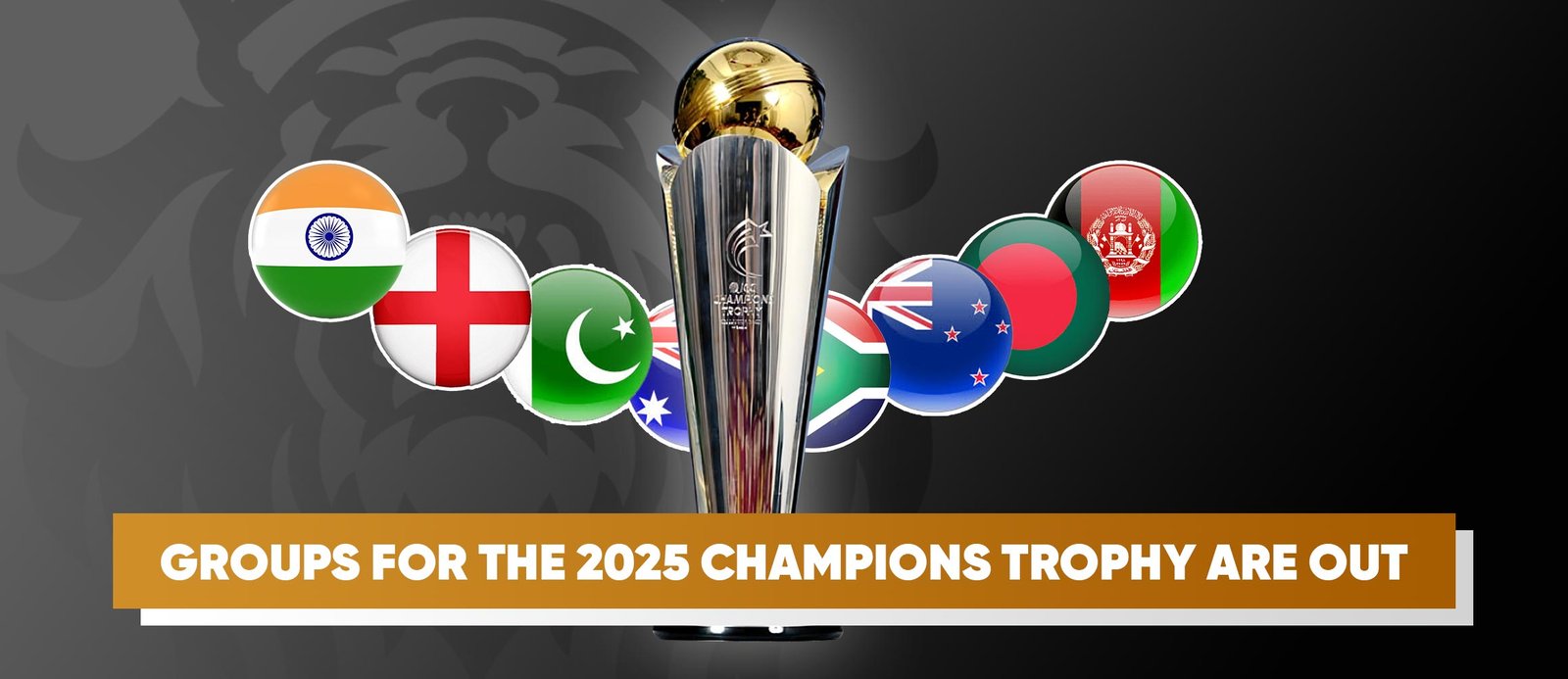
Groups For The 2025 Champions Trophy Are Out
• 04 Jul, 24 • by Champ11Yo, cricket fanatics! The groups for the 2025 Champions Trophy are out, and it's a real humdinger! Pakistan, the champs from 2017, are eyeing glory again on home turf.
-

Most Catches by A Fielder in T20 World Cup History
• 17 Apr, 24 • by Champ11The ICC Men's T20 World Cup isn't just about phenomenal batting and bowling. Catches win matches, too, and some fielders have made a name for themselves with their acrobatic grabs and safe hands. Here's a look at the top 3 players with the most catches by a fielder in T20 World Cup history: AB de Villiers, the legendary South African batsman nicknamed "Mr. 360"